How do you write an artist CV?
An open call closes on Friday and they want a CV with exhibitions. You sit down to reconstruct from memory which show you were in back in 2023, and the gallery email that confirmed it is nowhere to be found.
Here are the sections it needs, the order they go in, a complete example to copy, and how to make the CV write itself over the year.
How is it different from a normal CV?
It does not say where you worked. It says where your work was seen.
An artist CV is a list of verifiable facts: exhibitions, awards, residencies, collections, publications. No photo, no career objective, no list of skills. Nothing like "artist passionate about colour".
Whoever reads it is checking a track record, not a personality.
CV, bio and statement: which is which
They get asked for together and confused constantly. They are three different things:
| What it is | Length | Person | |
|---|---|---|---|
| CV | A list of verifiable facts | 1 to 4 pages | — |
| Bio | A paragraph summing up your path | 80 to 150 words | Third |
| Statement | What you are after in your work, and why | 150 to 300 words | First |
The bio is written in the third person ("She has worked in Valencia since 2017") because it gets printed in catalogues and press releases. The statement is in the first person, because it is yours.
If a call asks for "CV and statement", it is asking for two files. Sending one document with everything mixed together is one of the fastest ways to get a submission set aside. The statement belongs in the portfolio dossier.
What sections does it need?
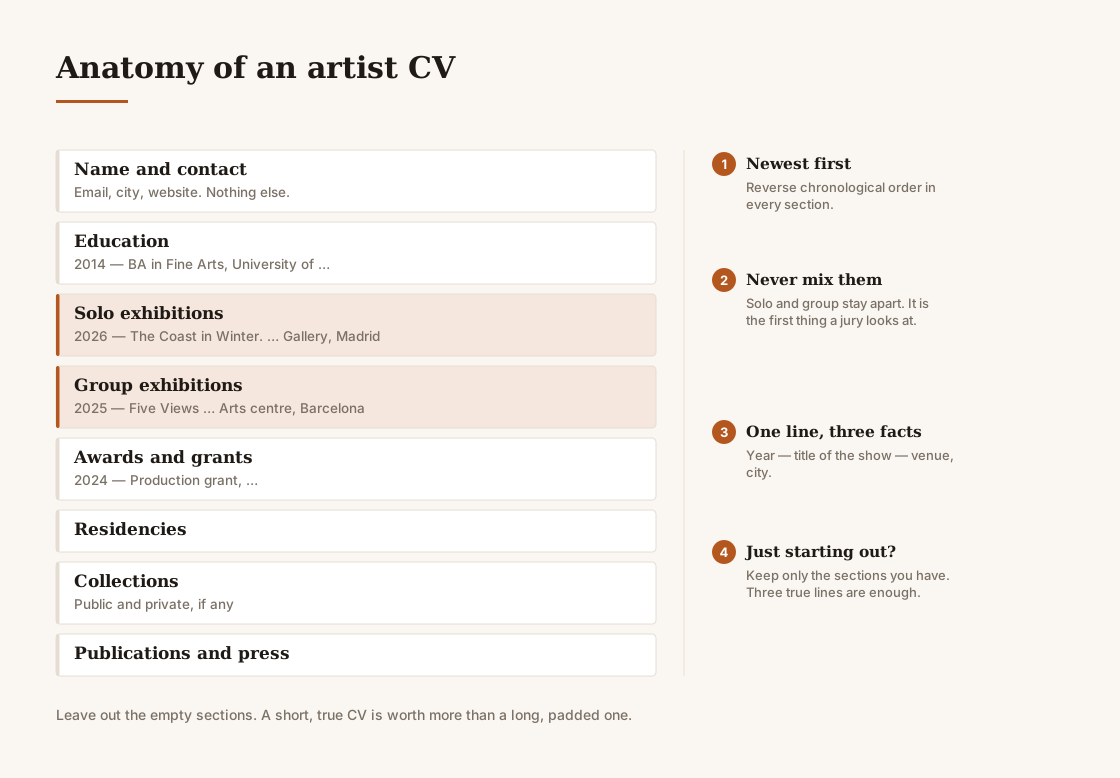
In this order, skipping the ones you do not have:
- Details. Name, year and place of birth, where you live and work.
- Education. Degrees, and also workshops or critique groups, with who led them.
- Solo exhibitions.
- Group exhibitions.
- Residencies.
- Awards and honours.
- Collections. Public first, private after, and only if you have permission to name them.
- Publications and press.
- Contact.
Keeping solo and group apart is the convention and it is not worth skipping. Mixing them reads as padding the list.
How do I order the exhibitions?
Most recent first, always.
Each line carries year, title of the show, venue and city. Like this:
2026 — Title of the show, Such-and-such Gallery, London
If it was curated by someone known in your field, add "curated by". If it was at a fair, name the fair and the gallery that represented you.
Be consistent with the format. A list where some lines have a city and others do not is noticed immediately.
A complete example
This is what it looks like assembled. It is fictional, but the shape is exactly the one worth copying:
ANA EXAMPLE
1988, Rosario, Argentina. Lives and works in Valencia, Spain.
ana@example.com · example.com

EDUCATION
2016    Critique group with Name Surname, Valencia
2014    BA in Fine Arts, University of …

SOLO EXHIBITIONS
2026    The Coast in Winter, … Gallery, Madrid
2023    Interiors, … Space, Valencia

GROUP EXHIBITIONS
2025    Five Views of the Everyday, curated by …,
        … arts centre, Barcelona
2024    … Painting Prize (shortlist), … Museum, Zaragoza

RESIDENCIES
2022    … Residency, Portugal

AWARDS AND HONOURS
2024    Production grant, … Foundation
2021    Honourable mention, … Municipal Salon

COLLECTIONS
        Collection of the City of …
        Private collections in Spain and Argentina

PUBLICATIONS AND PRESS
2026    "Title of the piece", Name of the outlet, 14 April
Notice the dates sit in one column and everything else in another. That alignment is what makes it readable at a glance, and it is the first thing lost when a CV is written in a hurry.
How long should it be?
As long as your track record, with one limit: if the call asks for one page, it is one page.
Keep two versions of the same CV:
- The full one, with everything, which grows every year.
- The short one, a single page, where each section is trimmed to the most relevant of the last five years.
Preparing the short one takes ten minutes if the full one is current, and it is the one you will be asked for nearly every time. It does not work the other way round: nobody builds the full one in a rush.
What if I am just starting out?
Put down what you have, without dressing it up.
A short, honest CV reads better than a stretched one. People who judge open calls for emerging artists know exactly what a beginner's CV looks like, and they spot filler immediately.
These do count: shows in independent spaces, print art fairs, critique groups, self-published work. Craft fairs and end-of-course shows do not count as exhibitions, and putting them in works against you.
If you have two lines, have two lines. But two real ones.
Mistakes that show immediately
- Mixing solo with group. It is the first thing a jury looks at.
- Inflating a big group show. If you showed alongside forty others, it goes under group, not solo.
- Listing a private collection without permission. Ask the collector before naming them.
- Inconsistent dates. Either all of them carry a month or none do. Pick one and hold it.
- Sending it as a Word file. It falls apart on someone else's computer. Always PDF.
- Naming the file
cv.pdf. Whoever receives eighty submissions ends up with eighty identical files.
Name the file like this: Surname-Name-CV-2026.pdf. It costs nothing and sets you apart from half the entries.
What should I use?
A Word document you update each time. It works. The problem is remembering to update it, which nobody does until a call is closing.
A template you bought solves how it looks, but you are still reconstructing from memory.
With Artium, if you log each show as it happens — with its dates, the venue and the city — the CV comes out as a PDF with exhibitions already split into solo, group and residencies, in reverse chronological order. You did not write it on Thursday night: you have been writing it all year without noticing. Free with an Artium watermark; with the subscription you add your own signature, brand and colour, and the Artium mentions disappear.
Artium was built from inside a studio, with an artist who had this problem every year. If anything here rang true, the app takes care of it for you, with nothing to remember.
Whatever you use: log the next show the day it opens. It takes a minute, and it is the difference between having a CV and rebuilding one.
Keep reading
- How to build an artist portfolio dossier — where the bio and the statement go.
- What an art inventory is — where the records that feed the CV come from.
- Exhibition wall labels — what you need on install day.